
Nowadays, subscription models are used in nearly every industry. Growing companies like Netflix, Dollar Shave Club, and Microsoft have been using a subscription-based revenue model for years with much success. The good news? Your company can, too.
In this post, let’s discuss what a subscription business model is, how it works, and the benefits of using this model. Then, we’ll list a few examples of subscription models that you can use as inspiration for your business.
What’s a Subscription Business Model & How Does It Work?
A subscription business model is a recurring revenue model in which customers pay a weekly, monthly, or yearly fee in exchange for your products or services. Customers can renew their subscription after a certain period of time. This model allows you to leverage your customer relationships to create a steady stream of income.
Subscription-based revenue models benefit both the company and the customer. As a customer, you have the convenience of automatically repurchasing a product or service that you know you’re going to need in the future. As a business, you retain customers for future sales rather than needing to re-engage them on a more frequent basis. You secure monthly recurring revenue (MRR), which can keep your business afloat throughout the worst times.
For the right product, brand, and industry, a subscription model can be a very effective and lucrative approach to running your business. For example, you could build a subscription box business that makes millions per year with the right marketing.
Let’s learn a little bit more about how this business model works in the next section.
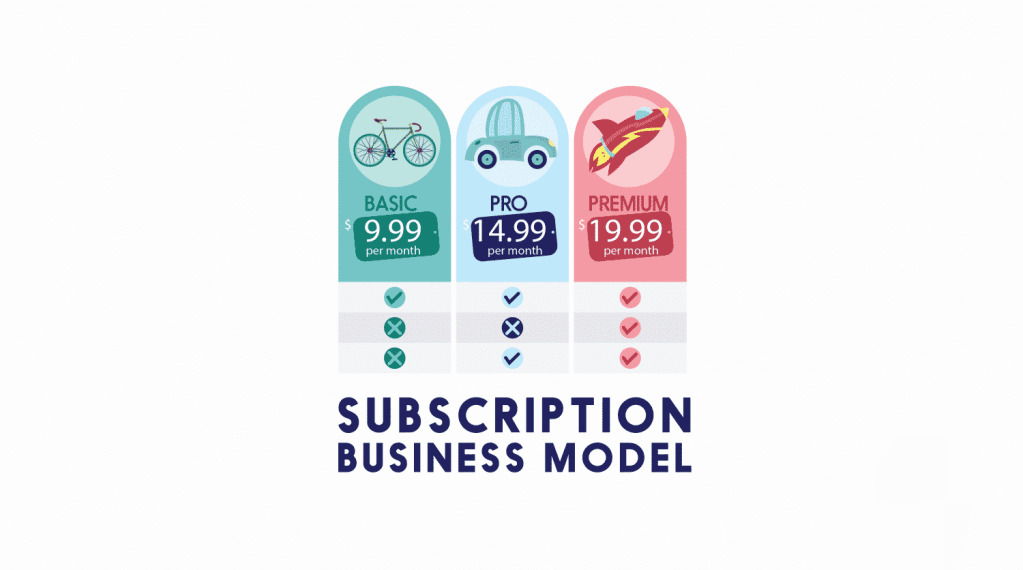
Subscription business models are beneficial for many organizations because they encourage customer success and improve buyer retention.
Nowadays, subscription models are used in nearly every industry. Growing companies like Netflix, Dollar Shave Club, and Microsoft have been using a subscription-based revenue model for years with much success. The good news? Your company can, too.
How a Subscription Model Works
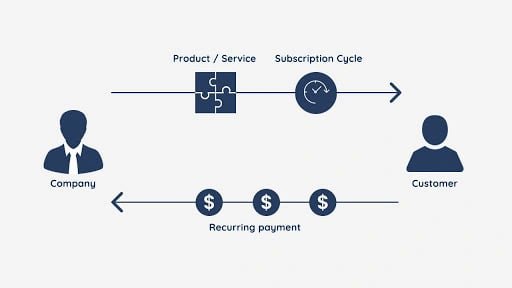
In a subscription model, customers are charged on a recurring basis for a product or service. They choose how long and how often they want to receive each offer, and most subscriptions provide the option to renew or cancel at any time.
Think of a subscription as a contract between you and the customer. The customer agrees to pay for a product or service for a period of time and the business fulfills that offer so long as the customer completes their recurring payments. When the contract is up, the customer has the option to renew or cancel their subscription.
The diagram below illustrates what this looks like.
A great example is your local newspaper. While you can buy newspapers individually, most who read them have a subscription. That way, you get a newspaper delivered to your front door for a fixed rate, rather than having to go to the store to purchase one.
How to succeed with a subscription business model
Subscription business models have become an increasingly disruptive force in the economy. While business to consumer (B2C) companies have offered subscription services for hundreds of years, business to business (B2B) subscription models have recently exploded onto the market, particularly with the arrival of software-as-aservice (SaaS). For B2C customers, the appeal of subscriptions includes a convenient buying experience, technological advances (e.g. move from music CDs to streaming music), and a tailored shopping experience. For B2B customers, the advantages include freeing up capital budgets, offloading repair and maintenance and getting regular updates and service improvements. For companies offering subscription services, the advantages include building direct channels to customers, and capitalizing on recurring, predictable revenue—while providing new ways to differentiate from the competition to retain customer loyalty. Today, everything from music, to software, devices and heavy machinery can be delivered “as-a-service”. In an August 2020 report, the global subscription e-commerce market was valued at $13.2 billion (USD) in 2018 and is anticipated to grow exponentially to $478.2 billion by 2025. The report also found that the subscription business proved to be resilient during the COVID-19 pandemic. Here are some recommended best practices to help improve your chances of success with your subscription business.
5 best practices for implementing subscription business models.
1. Analyze business models to increase probability of success
Companies may be reluctant to make dramatic changes in their business models due to the risk of making the wrong moves. They also recognize that doing business as usual is not an option, and that moving to a subscription business model is an imperative for survival. Fortunately, an enterprise-grade scenario modeling solution can help executives make better decisions. Once you have identified your potential subscription revenue opportunities, scenario modeling can be used to help you determine such aspects as the optimal price points and breakeven points. You can model your options using various inputs such as the cost to manufacture the products you want to offer as a service, the cost to provide the services, the cost to repair and maintain products as well as the anticipated revenue. You then run simulations to determine how to structure your service offerings to increase your probability of success.
2. Nurture personalized engagements with your customers
A subscription business naturally lends itself to being more engaged with customers. To be most successful you’ll want to develop and nurture personalized engagements with your customers. This best practice entails three essential characteristics. First, entice your customers with an actual or perceived exclusive experience. Second, actively listen to your customers through feedback mechanisms, digital behavior and usage patterns to learn all you can about their needs and what motivates them. And third, continually nurture the relationship through such things as tailored discounts for B2C customers and business consultancy for B2B customers. The benefits of personalizing engagement with customers includes better loyalty and gaining a better understanding of changing customer needs, both of which can lead to lower churn and higher retention rates. To nurture personalized engagements also requires businesses to build completely new skill sets. For example, traditional, long-time consumer product goods (CPG) companies that optimized around grocery and convenience channels, with competency on fulfillment and product placement, never had direct customer interactions. Adding a subscription model requires CPG companies to develop a completely new array of skills and competencies to leverage the new insights gained from personalized engagements.
3. Execute flawlessly to delight your customers
One of the biggest advantages of a subscription business model is that you’re more in control of customer retention. Simply, once a customer has engaged you through the subscription service, it’s up to you to flawlessly delight your customers to help keep renewals high and churn low. One way to achieve this goal is with solutions that simplify complex processes across multiple systems and touchpoints, and that support thousands of engagement points across pricing, delivery, and billing models. Give your sales and service teams the tools they need to easily modify, manage, and renew deployment options. Deliver negotiated pricing, usage, or terms with subscription-based quotes and orders.
4. Leakage and revenue recovery
While shifting to a subscription business model has enormous potential, it comes with some unique financial challenges. While the concepts of revenue leakage and revenue recovery are not new, the subscription business model imposes new and unexpected dynamics. It is therefore imperative to establish clear accountability within your organization to manage both areas. Revenue leakage is money owed to you but never billed to your customers. To minimize leakage, look for an ERP system that has the following to help minimize billing errors: a tight integration between subscriptions management, price quoting and billings; ability to track different usages and execute metered billing; ability to deploy automatic expirations of discounts. Revenue recovery happens when your customers don’t pay you. With a subscription business, the volume of billing transactions can be very high while the monthly billed amounts can be lower. In addition, disputes may arise over the billings due to such things as unprocessed discounts or usage amounts. To help your collections department, look for an ERP system that provides for such things as customized collection strategies and promise-to-pay solutions for risky and delinquent customers.
5. Evolve subscription models based on data insights
It’s essential to routinely watch, listen and learn about customer purchasing and other behaviors. This will help to identify profitability and other changes early (e.g. churn rates) so you can quickly evolve your subscription business model based on intelligent insights gained from the data. You can improve your renewal management by ensuring it’s easy for your customers to renew their subscription. You can also minimize customer churn with intelligent insights that help you identify at-risk customers early to improve renewal rates. Intelligently determine cross- and up-sell opportunities for customers with additional needs so you can continue to expand your relationship and your customer lifetime value.
Steps to get started
1. Evaluate your business opportunities and models
It’s important for innovative companies to evaluate both existing and potential subscription business models based on dynamic market conditions. Cloud application suites are helping innovators adapt to changing market conditions—delivering the tools and visibility to quickly innovate, develop, configure, and evolve new subscription offerings in response to customer demands.
2. Determine how you’ll use key subscription business metrics
A subscription business requires a different set of metrics to evaluate the success of your subscription offerings. As outlined in 6 Key metrics for a subscription business, determine which metrics are important to your business. Of the 6 metrics, CFOs and CROs should focus on customer lifetime value since it plays a central role in determining the profitability of your subscription business.
3. Stay agile and alert to new opportunities
To achieve the best possible success with your subscription business, you should avoid the “set it and forget it” mindset. From evolving customer needs to technological advances, the market continues to rapidly change, and you need to stay agile and alert to new opportunities. With an updated system every quarter, businesses can leverage the latest SaaS technology to modernize processes, automate manual work, increase speed and spark innovation.
Quick reminders
Do:
👍Embrace digital ways of doing business
👍Listen to customer input
👍Have a mix of core and stretch offerings
👍Continually monitor KPIs Quick reminders
Don’t:
👎Rush to market with insufficient analysis
👎Be dissuaded by short-term revenue impact
👎Let silos build up between teams
👎Wait until year-end to measure success
Examples of Subscription Business Models
Subscription Box Business Model
Subscription boxes have become a very popular type of business model. Every month, customers receive a box filled with various products that are sometimes related to each other and sometimes not. The combined cost of these items typically outweighs the overall cost of the box.
Some companies let the customer choose what’s in the box, while with others, customers get the element of surprise while experiencing new products they may not have sought out on their own. This is a great way for a brand to familiarize its customer base with all of its products.
Subscription Box Example: Butcher Box
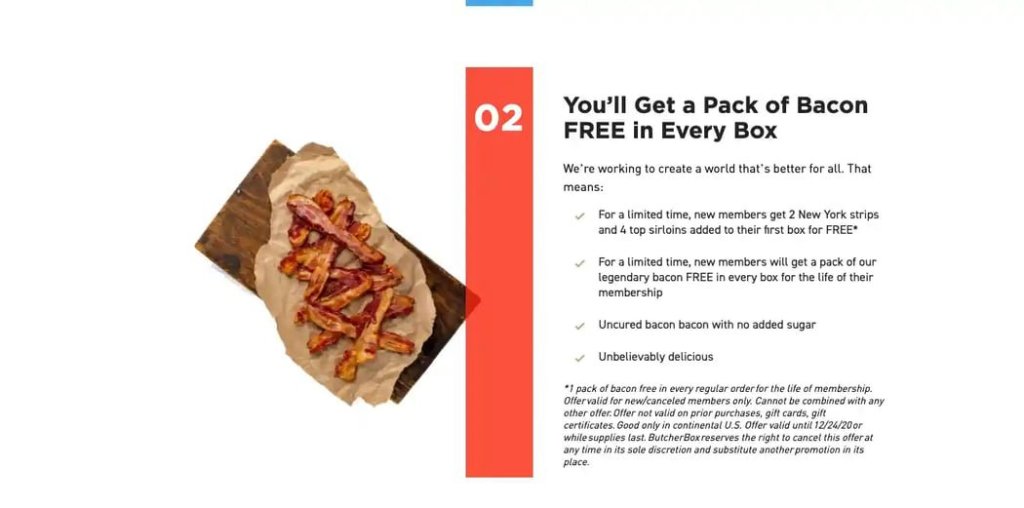
Butcher Box is a subscription box service that sends customers boxes of meat each month. Each box includes different cuts of meat as well as a few recipes for you to cook them with. This is a great way for carnivores and BBQ enthusiasts alike to try out different types of meat they may not have tasted or cooked before.
Streaming Service Subscription Model
Streaming services grant you access to things like movies, television, and music, for a monthly price. The benefit of this model is that consumers can access all of the entertainment content they need whenever and wherever they want.
Streaming Service Subscription Example: Hulu

Hulu is a popular streaming service that allows you to stream movies and TV shows from your computer, phone, or smart device. You can also access content on the go, so you can enjoy your favorite shows even when you’re not at home. With its flexibility and competitive pricing, Hulu has become a preferred entertainment alternative for cord-cutters looking to move away from cable TV.
Food Service Subscription Model
If you’re looking to mix up your dining routine, then you may want to consider a food service subscription. These companies not only deliver food to your doorstep, but they also provide you with recipes to cook with. That way, you’re getting both the ingredients and direction needed to make a home-cooked meal — even if you don’t have any cooking experience.
Food Service Subscription Example: HelloFresh
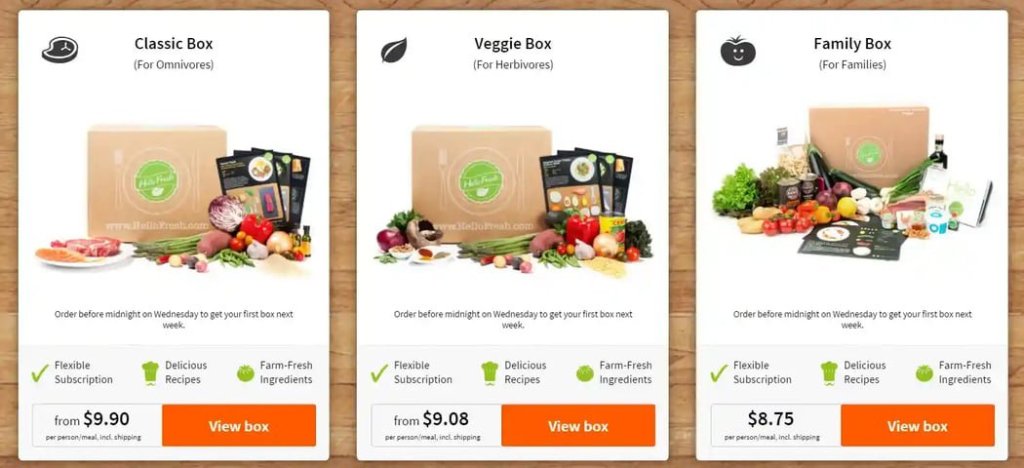
HelloFresh is a food subscription service that delivers all of the ingredients needed to cook a complete meal. Each box includes individually wrapped packages of food — with each one measured out to the exact portion needed in the recipe. HelloFresh saves you time from having to do prep work since all of your ingredients are measured and prepacked when you receive the box.
Health and Wellness Subscription Model
Tired of going to the gym for your daily workout? With a health and wellness subscription, you can get access to classes, trainers, and workout equipment all for a monthly fee.
Health and Wellness Subscription Example: Yoga International

Yoga International is an online yoga studio where you can attend interactive workout classes from the comfort of your home. Rather than having to adhere to a gym’s set schedule, you can choose when and where you want to work out.
SaaS Subscription Model
SaaS subscription models are maybe the most common type of subscription model in the market right now. Google Workspace, HubSpot, Adobe, and Slack all have subscription models, meaning that you pay a monthly fee to have access to their software. If and when you stop paying, you only have access to the software until the end of the billing period.
Many software companies use subscription models because they often update and improve their products and services regularly. Rather than asking customers to repurchase the product every time a change is made, they use a software subscription model, which lets them make improvements without hindering the customer experience.
SaaS Subscription Example: HubSpot
All of HubSpot’s products are offered on a subscription basis. And, this makes sense, too, since HubSpot routinely updates and improves its products daily. If they weren’t offered as a subscription, HubSpot would have to update its pricing every day to reflect the changes made to its product. Not only would this be confusing for HubSpot, but its customers would be wondering why different customers are paying different prices for the same products.
A Subscription Business Model Will Help Your Business Grow
This is just a small taste of the industries benefiting from a subscription-based business model. With a little creativity and the right plan, you may find that this approach leads to happier customers and greater retention rates for your business as well, allowing you to grow exponentially.
 EFINO BUSINESS