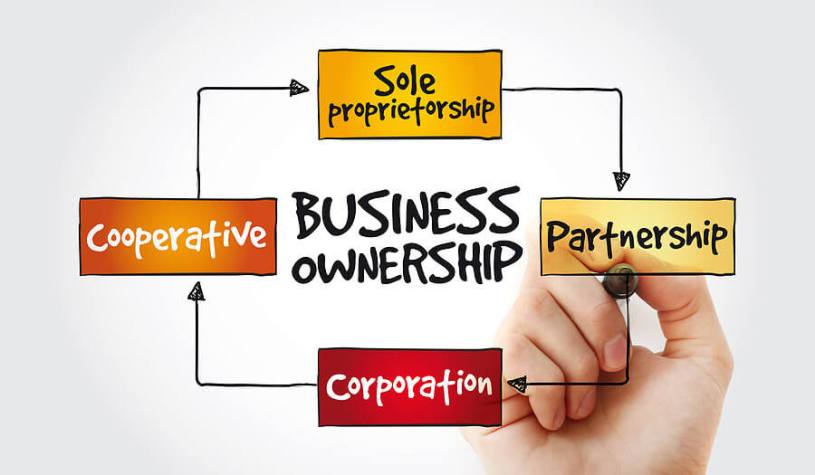
Business ownership structure refers to the legal and organizational framework that defines how a business is owned, operated, and structured. The choice of ownership structure has significant implications for aspects such as liability, taxation, decision-making, and fundraising. There are several common business ownership structures, each with its own characteristics:
- Sole Proprietorship:
- Ownership: Owned and operated by a single individual.
- Liability: The owner is personally liable for business debts and legal obligations.
- Taxation: Business income is typically reported on the owner’s personal tax return.
- Decision-Making: The owner has complete control over decision-making.
- Ease of Formation: Easy and inexpensive to set up.
- Partnership:
- Ownership: Owned by two or more individuals or entities (partners).
- Liability: Partners share liability for business debts and obligations, but liability varies based on the type of partnership (general, limited, etc.).
- Taxation: Income is usually passed through to the partners’ individual tax returns.
- Decision-Making: Partners share decision-making responsibilities as defined in a partnership agreement.
- Ease of Formation: Relatively easy to form, with a partnership agreement outlining roles, responsibilities, and profit-sharing.
- Limited Liability Company (LLC):
- Ownership: Owned by members (individuals or entities).
- Liability: Members’ personal assets are protected from business debts and liabilities. Members have limited liability.
- Taxation: LLCs have flexibility in choosing their tax treatment, which can be like a sole proprietorship, partnership, S corporation, or C corporation.
- Decision-Making: Management can be structured as member-managed or manager-managed, depending on the operating agreement.
- Ease of Formation: Moderate ease of formation with less administrative burden than a corporation.
- Corporation:
- Ownership: Owned by shareholders who hold shares of stock.
- Liability: Shareholders have limited liability; their personal assets are generally protected from business debts.
- Taxation: Corporations are subject to double taxation (taxed at the corporate level, then again on dividends to shareholders). However, S corporations offer pass-through taxation.
- Decision-Making: Shareholders elect a board of directors who make key decisions, and officers handle day-to-day management.
- Ease of Formation: More complex and costly to form due to regulatory requirements.
- Cooperative (Co-op):
- Ownership: Owned and democratically controlled by its members, who can be customers, employees, or both.
- Liability: Members typically have limited liability.
- Taxation: Cooperatives often have tax advantages, and profits are distributed among members based on their use or investment.
- Decision-Making: Members have a say in decision-making through voting, typically following the principle of one member, one vote.
- Ease of Formation: Formation can be more complex due to cooperative principles and governance.
- Franchise:
- Ownership: Franchisor (the parent company) grants the franchisee (individual or entity) the right to operate a business using the franchisor’s brand, products, and systems.
- Liability: Typically, franchisees have liability for their specific franchise location.
- Taxation: Taxation varies based on the legal structure of the franchisee’s business.
- Decision-Making: Franchisees follow the franchisor’s operational guidelines and standards.
- Ease of Formation: Easier entry into business with the support of an established brand.
The choice of business ownership structure should align with your business’s goals, risk tolerance, funding needs, and legal requirements. It’s important to consult with legal and financial professionals when deciding on the most suitable structure for your business.
 EFINO BUSINESS