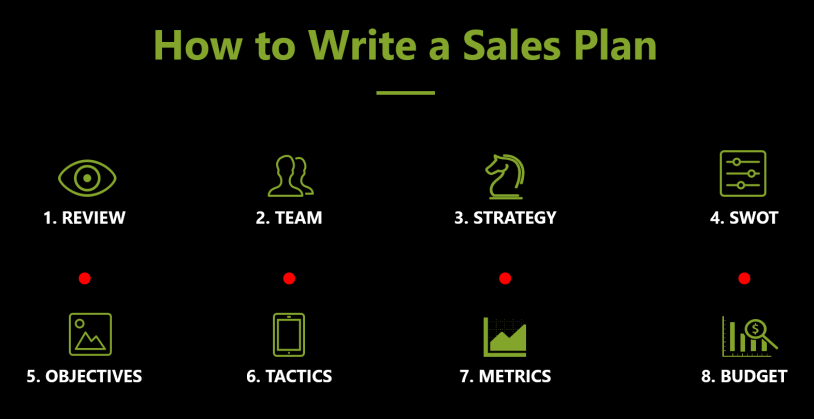
Here’s a sales plan that you can use as a framework for your business:
1.Define your sales goals:
Start by clearly defining your sales objectives. Set specific, measurable, attainable, relevant, and time-bound (SMART) goals that align with your overall business objectives. For example, you might aim to increase sales by 20% over the next quarter.
2.Identify your target market:
Determine your ideal customer profile and identify your target market segment. Understand their demographics, psychographics, pain points, and buying behavior. This information will help you tailor your sales approach and messaging.
3.Develop a sales strategy:
Based on your target market analysis, develop a sales strategy that outlines your approach to reaching and engaging potential customers. Consider factors such as pricing, distribution channels, promotional activities, and customer relationship management. [read more…]
4.Build a sales team:
Recruit and train a competent sales team that possesses the skills and knowledge required to effectively sell your products or services. Provide ongoing training and support to enhance their selling abilities.
5.Create a sales process:
Develop a systematic sales process that guides your team from lead generation to closing deals. Define the key steps, responsibilities, and timelines involved in the process. Incorporate feedback loops and performance metrics to continuously optimize and improve the process.
6.Generate leads:
Implement lead generation strategies to attract potential customers. This can include online marketing, content marketing, social media campaigns, search engine optimization, networking events, referrals, and partnerships. Use a mix of inbound and outbound lead generation techniques to maximize your reach. [read more…]
7.Qualify leads:
Once leads are generated, qualify them to identify the ones with the highest potential for conversion. Develop criteria to evaluate leads based on factors such as budget, authority, need, and timeline (BANT). This will help your sales team prioritize their efforts and focus on the most promising opportunities.
8.Nurture customer relationships:
Build strong relationships with your prospects and customers through regular communication and personalized interactions. Implement customer relationship management (CRM) tools to track customer interactions, preferences, and purchase history. Provide exceptional customer service to enhance customer satisfaction and foster loyalty.
9.Deliver persuasive presentations:
Train your sales team to deliver compelling presentations that effectively communicate the value proposition of your products or services. Tailor your presentations to address the specific needs and pain points of each prospect, highlighting how your offering can solve their problems or fulfill their desires. [read more…]
10.Handle objections:
Equip your sales team with the skills to handle objections and overcome customer concerns effectively. Anticipate common objections and develop strategies to address them. Encourage active listening, empathy, and problem-solving to build trust and credibility with potential customers. [Read more…]
11.Close deals:
Implement effective closing techniques to convert prospects into paying customers. Create a sense of urgency, offer incentives, provide clear and concise pricing and terms, and address any remaining concerns. Follow up with leads to ensure a smooth transition from the sales process to the fulfillment of the product or service. [Read more…]
12.Measure and analyze:
Establish key performance indicators (KPIs) to track the success of your sales efforts. Monitor metrics such as sales revenue, conversion rates, average deal size, customer acquisition cost, and customer lifetime value. Analyze the data to identify areas of improvement, make data-driven decisions, and adjust your sales strategy accordingly. [Read more…]
13.Continuous improvement:
Regularly review and refine your sales plan based on feedback, market trends, and performance metrics. Stay updated with industry advancements and incorporate new sales techniques or technologies that can give you a competitive edge. [Read more…]
Extra-note
Remember, a sales plan should be flexible and adaptable to changing market conditions. Regularly evaluate your progress and make necessary adjustments to optimize your sales performance.
 EFINO BUSINESS